A small Romo robot from the back of a shelf, and a first-generation iPhone SE dug out of a pile of old gadgets. My new Kindle book, Physical AI: A Robot Development Diary, follows the nine days it took to connect them to generative AI and turn them into a companion that stops when you call its name, answers when you ask, and then moves.
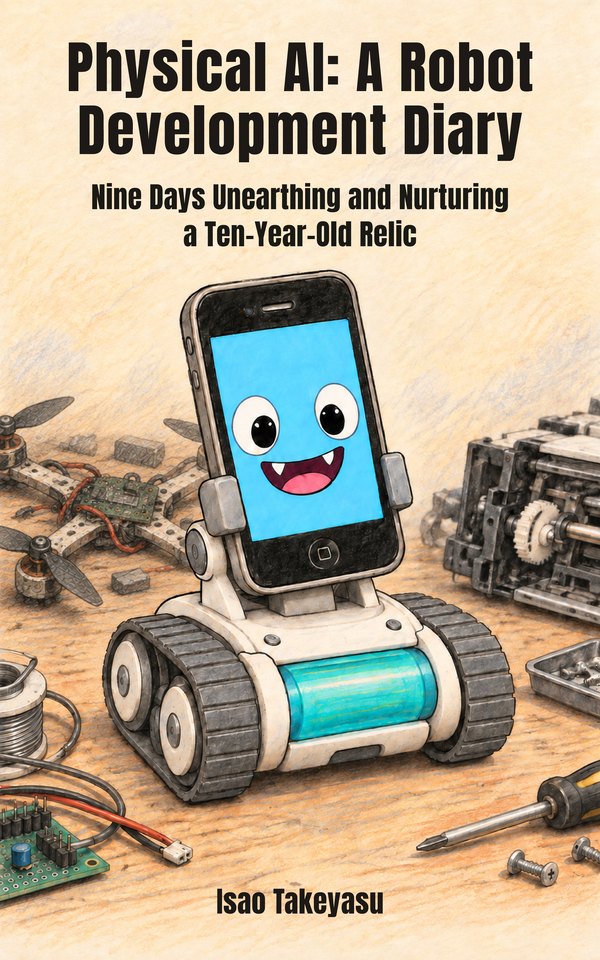
What this post covers
- What Physical AI: A Robot Development Diary — Nine Days Unearthing and Nurturing a Ten-Year-Old Relic is about
- The system design that splits the work between a server PC, an iPhone, and the robot's base
- The public repository for the app and server developed in the book, and the original Romo app and SDK
What the book is about
The subject is Romo, an educational toy robot that made a striking debut on Kickstarter in 2012, raising far more than its funding goal. It was a groundbreaking product: you dock an iPhone into a small tracked base, and the iPhone becomes its face as it drives around. Today its maker, Romotive, has evolved into Zipline, a company that delivers medical supplies by drone. Its consumer product business, including Romo, has wound down, and repairs and spare parts are no longer provided.
Using the design philosophy of Romo — a product that has vanished from the market — as a guide, the book tells the story of rebuilding it as a physical AI robot powered by generative AI, written to be as readable as possible and understandable even without technical knowledge.
In development, the hardware was left alone and the intelligence was put outside the robot. Words spoken to the robot go to a PC acting as a server. The PC works with AI to assemble a behavior scenario and sends it back. The robot then carries it out with its own camera, microphone, and tracks.
Works with AI to assemble behavior scenarios
Sees, hears, and executes scenarios
Drives the tracks and tilts the head
The technical topics the book covers include dividing roles in a system with physical control, designing a message format for behaviors, troubleshooting on real hardware, and human–AI collaboration.
The narrator sets the architectural direction, and an AI development partner helps turn it into working software. Tracks that stop after a single twitch. A robot responding to its own voice. The challenge of recognizing its name. Each problem calls for physical observation, displays and logs that reveal internal state, and another conversation with the AI development partner. Reading the original app and SDK also uncovers the ingenuity of earlier developers.
Just as the robot with its new generative-AI brain was about to start running, I was made to see something I had overlooked all along. What was it? Told in the first person, the book follows the nine days of trial and error in order, through conversations between the narrator and the AI development partner and the reactions of the family.
Contents
- Prologue: Calling Its Name
- Before We Begin: The Back of the Shelf
- Day 1: A Machine Still Asleep
- Day 2: That's Not Design
- Day 3: I'm Not Building a Remote-Controlled Toy / That'll Never Work
- Day 4: Alive for an Instant / The Drifting Head
- Day 5: A Dark World
- Day 6: A Relic Goes for a Walk
- Day 7: A Seven-Year-Old Voice
- Day 8: Always the Same Answer
- Day 9: Its Own Voice – Forward, Whole Body
- Epilogue: What It's Worth
- Repositories and Acknowledgements
Who it is for
You don't need a technical background to enjoy it as a development story. At the same time, it is written so that engineers who want to take everyday app and web development experience into robotics or IoT, or combine their own devices with AI, can draw practical insight from it. Through the concrete example of Romo, it offers a way of observing and designing that you can bring to your own projects.
The unboxing, ten years ago
I bought this Romo more than ten years ago as a gift for my son when he started elementary school, and wrote about the day it arrived on this blog:
- Romo Unboxing (April 2015)
The book opens with pulling that same base out from the back of a shelf.
Public repository and acknowledgements
- onthehand/Romo-Reimagined — the public repository for readers with the app and server developed in the book. Its README explains the published contents and how to use them
- Navideck/Romo — the original Romo app
- Navideck/Romo-iOS-SDK — the original Romo SDK
These gave us the means to read and understand the robot's structure and behavior throughout this project. I pay my respects to the engineering spirit of the people who developed and maintained the original Romo, and offer them my heartfelt thanks.
Get the book
- English edition: Physical AI: A Robot Development Diary — Nine Days Unearthing and Nurturing a Ten-Year-Old Relic (Kindle Edition) on Amazon.com
- Japanese edition: フィジカルAI ロボット開発日誌 ― 10年前の遺物を発掘して育てる9日間(Kindle版) on Amazon.co.jp
Related posts
- Romo Unboxing — the day I bought the Romo in this book
- I Used Claude Code to Write and Publish a Whole Book on My Crypto Auto-Trading System — my previous book

No comments:
Post a Comment